
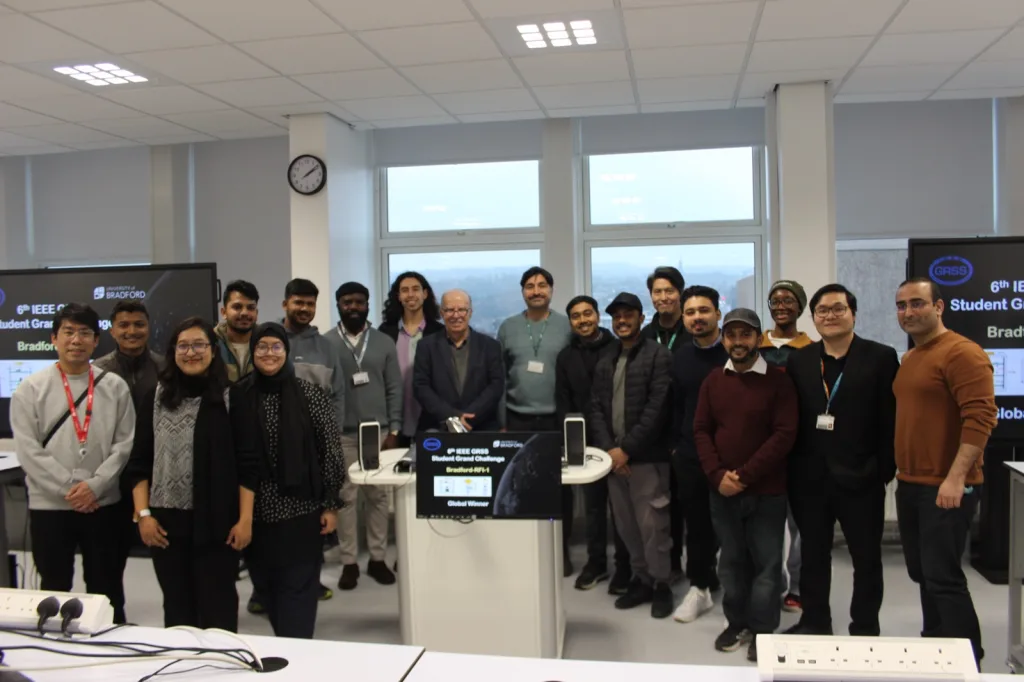
Students at the University of Bradford have been named among the global winners of a major international satellite engineering competition – becoming the only UK team ever selected in the challenge’s history.
The multidisciplinary group beat teams from around the world to take joint top honours in the prestigious IEEE Geoscience and Remote Sensing Society (GRSS) Student Grand Challenge, which tasks universities with designing satellite technology to tackle real-world problems using space science.
Bradford was chosen as one of just five winning teams worldwide, placing the city firmly on the global space innovation map.
Professor Savas Konur, Director of the Bradford-Renduchintala Centre for Space AI, said the achievement reflects the strength of student-led research at the university.
“This project shows how our students are able to combine advanced engineering, computing and AI to deliver work with genuine scientific and societal impact,” he said.
As part of their win, the Bradford team will receive $10,000 in seed funding to develop a flight-ready satellite payload, plus a further $2,000 to support their presentation at the 2027 International Geoscience and Remote Sensing Symposium (IGARSS), one of the world’s leading Earth observation conferences.
The winning project, titled BRADFORD-RFI-1, tackles a growing problem facing Earth-observation satellites: radio-frequency interference (RFI). Human-made signals from Earth can distort or corrupt satellite data used to monitor the planet.
In practical terms, this kind of interference can undermine measurements used to track climate change, sea ice, soil moisture, ocean temperatures and extreme weather – information relied on for environmental protection and long-term planning worldwide.
To address the issue, the Bradford students are designing a compact PocketQube satellite that will detect and analyse interference in a protected part of the radio spectrum, used by major international Earth-observation missions.
By identifying where and how disruption occurs, the data could help safeguard the accuracy of future satellite monitoring systems.
The 12-strong team brings together students from satellite engineering, computing, mechanical engineering, management, law and international business, supported by academic and industry advisers.
Team leader Zahid Hasan Shovon said the group was proud to represent both Bradford and the UK on a global stage.
“We are incredibly excited to be representing the UK and the University of Bradford on this platform,” he said.
“Our ambition is to deliver a fully flight-grade satellite payload within the project timeline.”
The project will now move through a full professional development cycle, including design reviews, engineering and flight model development, testing and, ultimately, launch and in-orbit operation.
Assistant Professor Vuong Mai said Earth-observation satellites underpin vital decisions about climate and environmental safety, while Professor Raed Abd-Alhameed added that detecting interference from such a compact satellite is a demanding technical challenge.
“This recognition reflects the technical strength of the students’ work,” he said.