
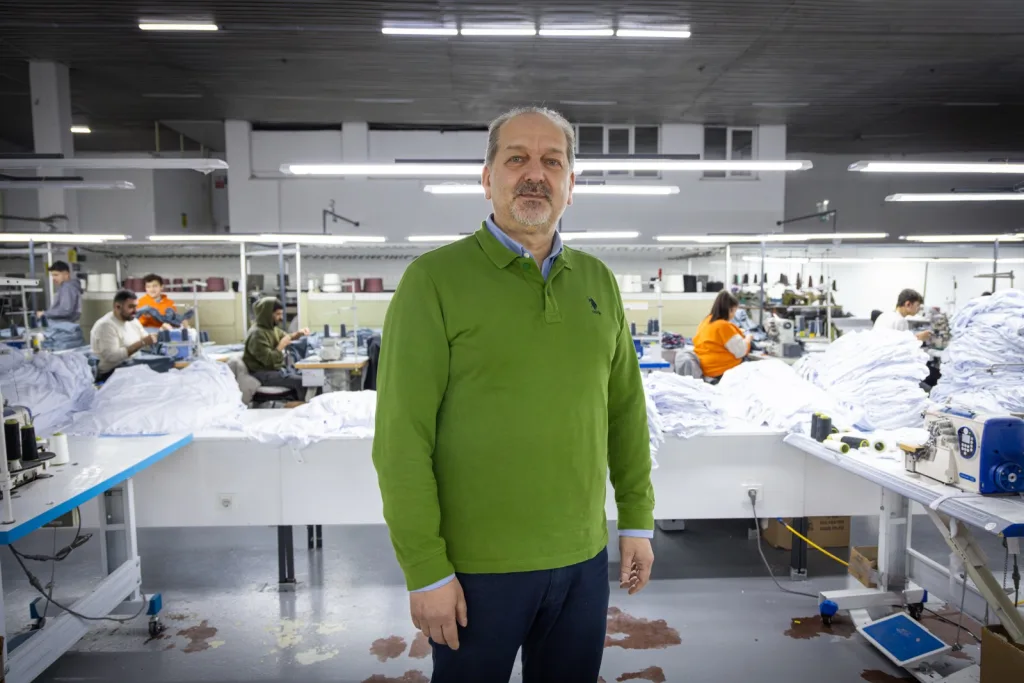
Inside a garment factory on the outskirts of Gaziantep, the steady rhythm of sewing machines tells a story of survival turned into renewal.
For Ghazwan, a 58-year-old Syrian entrepreneur, the workshop represents far more than commercial success – it is proof that lives and livelihoods can be rebuilt after forced displacement.
When war engulfed Syria, Ghazwan fled, leaving behind both his home and the textile business he had built over decades. After three years in Jordan, he moved with his family to south-east Türkiye, joining millions of Syrians grappling with the loss of stability and the challenge of starting again in a foreign country.
Yet Ghazwan carried with him one crucial asset: experience. “I’ve worked in the clothing industry since 1999,” he says. “I never once thought of giving it up.” With the backing of his family, he opened a small sewing shop – a modest beginning that would later grow into a factory employing both Syrian and Turkish workers.
The path was far from smooth. Establishing a business in a new country meant navigating unfamiliar regulations, securing permits and adapting to shifting markets.
More recently, soaring inflation, rising production costs and the aftershocks of the devastating 2023 earthquakes placed further strain on the operation, pushing many small firms in the region to the brink.
A timely grant from the International Organization for Migration (IOM), through its Enterprise Development Fund, proved decisive. The funding enabled Ghazwan to purchase machinery, secure raw materials and take on additional staff at a moment when liquidity was scarce.
“It helped us stabilise when many businesses were closing,” he says.
As production recovered, the company began expanding again, meeting export demand and securing international clients. Engineers and managers now work across multiple languages, including Turkish, Arabic, English and French, while new employees receive training to develop their skills.
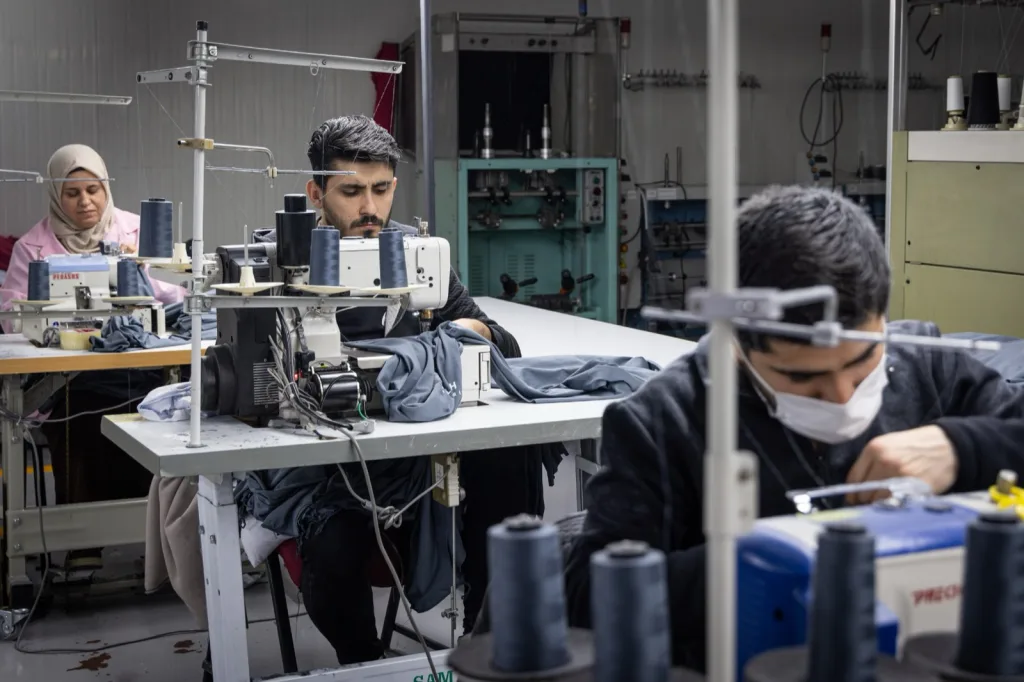
Diversity, Ghazwan believes, is central to the firm’s resilience. Syrian and Turkish workers sit side by side at long tables, stitching garments and solving problems collectively. “Different perspectives strengthen us,” he says, crediting Syrian staff with helping revive parts of the footwear market in particular.
Beyond productivity, the factory has become a small example of social integration in a region that has absorbed large numbers of refugees. Ghazwan insists on formal employment and registration, arguing that undocumented work leaves migrants vulnerable to exploitation. “It may cost more at first,” he says, “but it protects everyone in the long run.”
Looking back, he sees migration not only as a story of loss, but also of possibility. His business has contributed to the recovery of Gaziantep’s historic textile sector and created jobs in a challenging economic climate. Despite ongoing uncertainty, Ghazwan is focused on expanding markets and creating further opportunities.
“We’re stronger together,” he says. “If we work collectively, businesses and communities can both benefit.”
Since 2021, IOM has supported hundreds of micro, small and medium-sized enterprises across Türkiye through its Enterprise Development Fund, aiming to accelerate recovery and foster longer-term social and economic cohesion.