

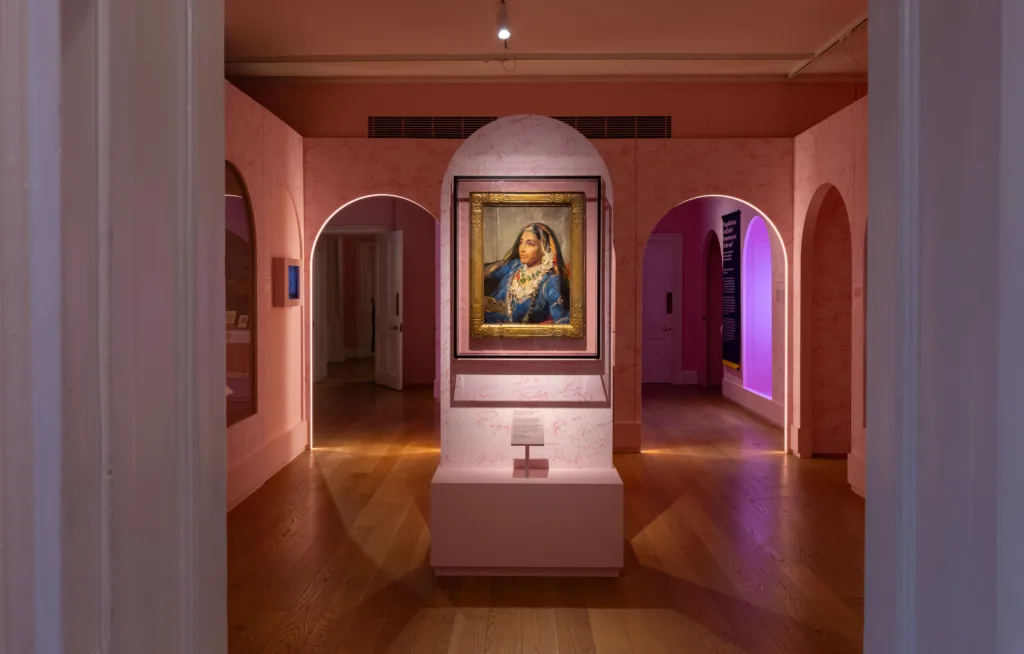
The Last Princesses of Punjab at Kensington Palace is a compelling and deeply personal exploration of the women behind one of the most complex chapters in Punjab’s history.
Marking what would have been Princess Sophia Duleep Singh’s 150th birthday, the exhibition brings together rarely seen photographs, letters, jewellery, clothing and personal belongings to tell the stories of six women: Sophia, her sisters Bamba and Catherine, their mother Bamba Müller, grandmother Maharani Jind Kaur and godmother Queen Victoria.
What makes the exhibition particularly engaging is that it moves beyond the familiar story of Sophia as a pioneering suffragette. Her activism is brought vividly to life through objects including her handwritten letter to Winston Churchill and the famous “No Vote, No Tax” banner associated with the suffragette movement. Yet the exhibition also gives space to the less familiar stories of her sisters.
Princess Bamba’s determination to reconnect with her Punjabi heritage is particularly striking. Her writings and personal belongings reveal a woman grappling with the loss of her family’s kingdom and her own complicated relationship with a homeland she had inherited through history but not experienced as her own. Catherine’s story is equally moving, particularly her efforts to support Jewish refugees fleeing Nazi persecution. At the heart of the exhibition, however, is the story of Maharani Jind Kaur. The reunion of her portrait with jewellery she wore and a preparatory sketch revealing her appearance creates one of the exhibition’s most powerful moments. Her story provides an important reminder of what was lost when the Sikh kingdom was annexed and her son, Duleep Singh, was taken from Punjab and brought to Britain.
There is also something deliberately uncomfortable about experiencing this history inside Kensington Palace. The exhibition explores the lives of women whose family was displaced by British imperial power while being presented within a palace so closely associated with Queen Victoria. That contrast adds another layer to the experience and encourages visitors to consider the relationship between privilege, empire, identity and resistance.
Importantly, the exhibition connects these historical stories with contemporary British South Asian voices. Creative responses from members of today’s communities explore themes of heritage, identity and resistance, helping to demonstrate why the stories of these women continue to resonate.
The Last Princesses of Punjab succeeds because it does not present these women simply as historical figures. Through their letters, photographs and possessions, they emerge as individuals negotiating displacement, privilege, identity and belonging in very different ways.
For anyone interested in Punjab’s history, the legacy of the Sikh Empire, the British South Asian experience or the history of women’s resistance, this is an exhibition worth making time for.
The Last Princesses of Punjab: The Story of Sophia Duleep Singh and the Women Who Shaped Her is at Kensington Palace until 8 November 2026 and is included with palace admission.
Book your tickets here: https://www.hrp.org.uk/kensington-palace/whats-on/the-last-princesses-of-punjab/
WRITTEN BY: Nura Arooj