

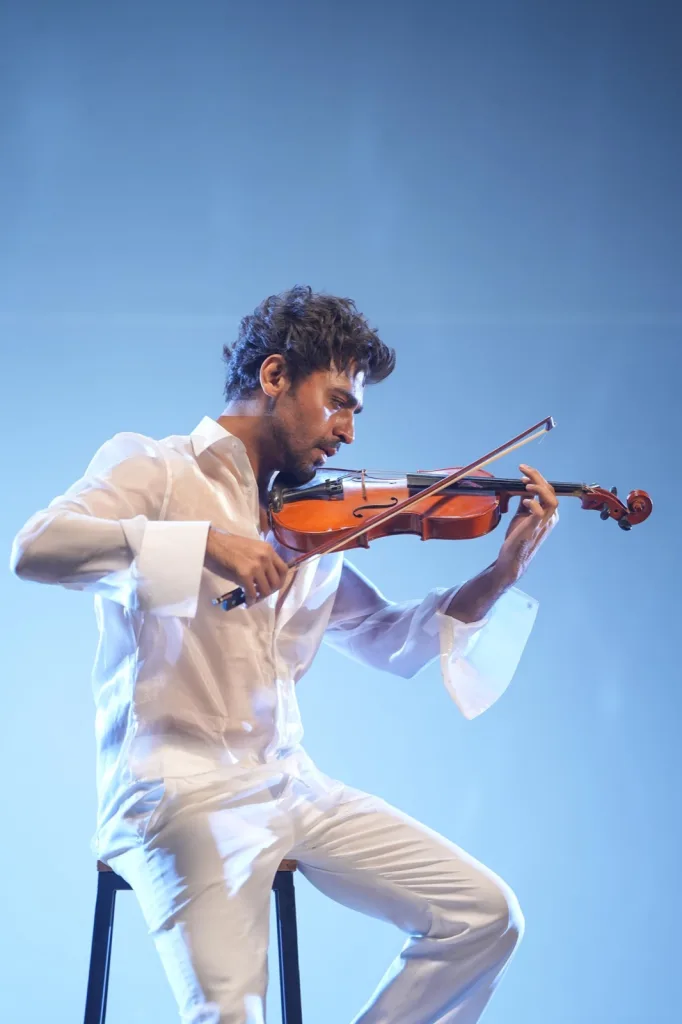
After conquering screens and soundtracks alike, Farhan Saeed is back where his heart has always lived – in melody, storytelling, and song.
His new album Khat is a deeply personal body of work, shaped by reflection, distance, love, and the unspoken emotions that linger between people. It marks a return to music after a period dominated by acting, and reveals an artist more self-aware, more vulnerable, and more honest than ever.
In this exclusive Asian Express Q&A, Farhan opens up about the emotional phase behind Khat, why introspection comes naturally to him, how his latest single expands the album’s world, and what he hopes listeners carry with them after the first listen.

Your album Khat feels deeply personal and reflective. What emotional or creative phase of your life does this body of work represent for you?
Khat comes from a phase where I had become a lot more aware of myself and my journey as an artist. I was doing acting as well and got quite busy with it, and that experience also shaped me. I learned a lot from the characters I played, from their emotions and perspectives. In a way, that helped my storytelling too.
But somewhere in the back of my mind, I always knew that I owed this piece of work to my fans. I wanted to give them a complete album, something honest and meaningful. So, I took a step back, gave myself time, and focused on Khat. I really enjoyed working on it and it felt like returning to a space that has always been closest to me – music, melody, and songwriting.
The songs on Khat explore vulnerability, distance, and unspoken emotions. Was there a conscious decision to lean into this introspective space, or did it emerge organically?
I’ve always been very honest with my writing. My songs have vulnerability, emotion, and a certain depth to them, and I think that’s what my listeners connect with – whether it’s the storytelling or the songwriting itself. That has always been my natural space as an artist.
While working on Khat, I didn’t consciously try to push myself in a specific emotional direction. It all emerged organically. I wrote the way I always do, from the heart, taking inspiration not only from my own life, but also from my experiences, the people around me, and the situations and environments I move through. The emotions in these songs came naturally, and I chose to stay true to them instead of forcing anything.
Your latest single builds on the sonic and emotional world of Khat yet feels distinct. How does it expand the album’s narrative?
For me, every song in Khat has its own identity, even though they all come from the same emotional space. The title track Khat was the first single and it really set the tone of the album – honest, reflective, and emotionally restrained in a way I connected with deeply while writing it. That song became the base of the world this album exists in.
Manzar, which is my second single, is also very special because I dedicated it to the love of my life, Urwa. It comes from a very real place, and I feel that sincerity ties it back to the rest of the album. Even when the mood or sound shifts across songs, the intention remains the same – to keep the music honest and emotional. So, this track doesn’t stand apart from the album, it expands the journey in a natural way.
As someone who has expressed himself through film, poetry, and music, how does songwriting on Khat allow you to communicate what other mediums perhaps don’t?
I have expressed myself through film and drama as well, but music and songwriting have always been my strongest and most natural space. This is where I feel the most connected to what I am creating. I genuinely enjoy nothing more than the process of composing and writing – it comes to me instinctively.
With Khat, I also allowed myself to experiment. There are songs where I stepped out of my comfort zone, both musically and emotionally. Songwriting gives me that freedom to explore different textures, different moods, and different ways of saying something without overthinking it.
Listeners have strongly connected with the honesty in your recent music. What do you hope audiences take away from Khat and the new single?
The interesting thing about this single is that it is not written as a direct reflection of my personal life. I do not want it to feel limited to one situation or one kind of experience. It is for anyone who is trying to move on from something – a relationship, a memory, a phase of life.
What matters to me is that people feel something when they listen to it. If listeners are able to find their own story in the song, interpret it in their own way, and connect with it emotionally, then that is exactly what I wanted from Khat.